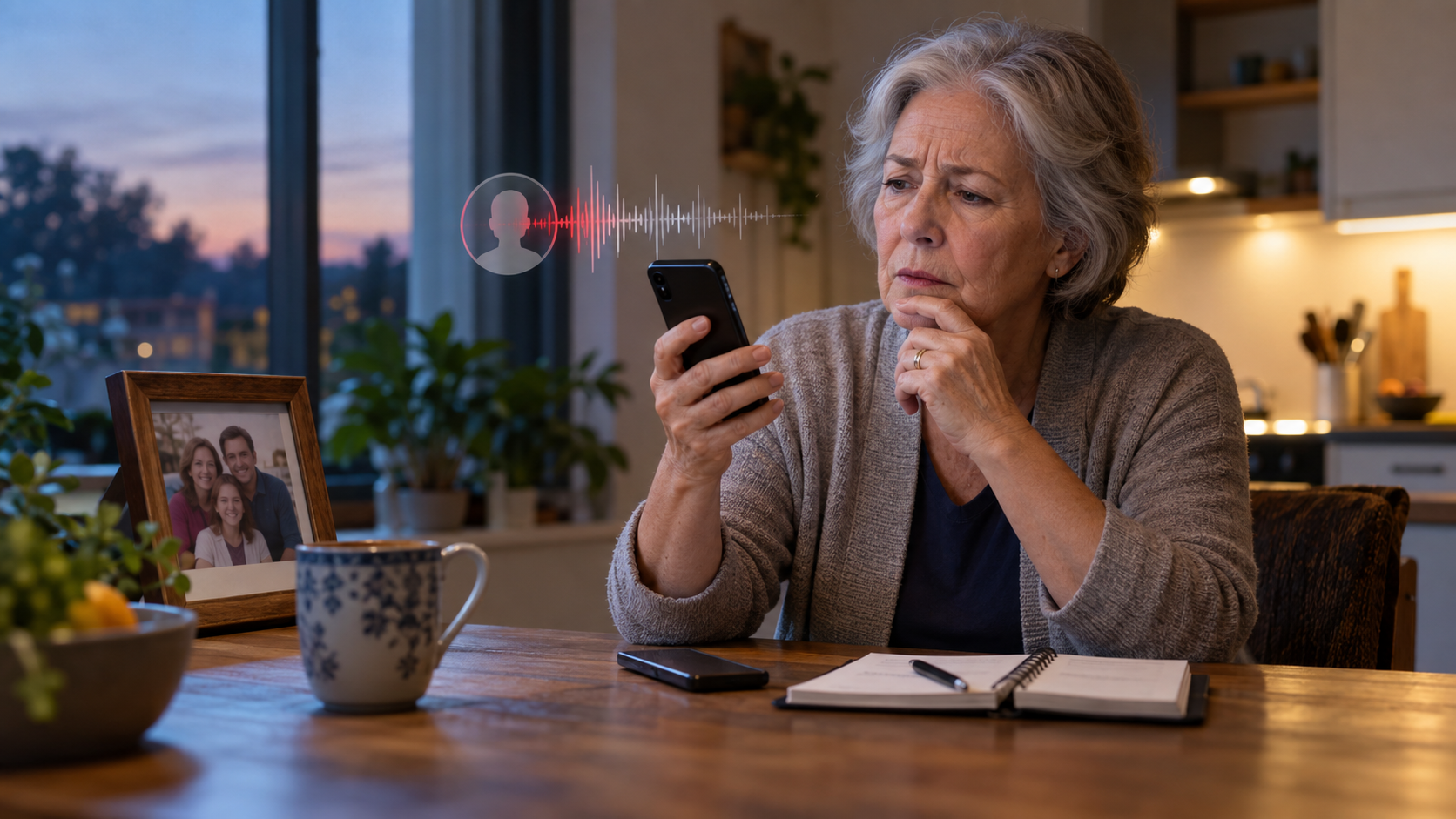
*A familiar voice is no longer proof of identity. With voice-cloning tools, a scammer can imitate someone you love and manufacture a crisis designed to make you act before you think.*
The call may sound convincing. A child, grandchild, partner or friend says there has been an accident, an arrest or a medical emergency. The voice is frightened. The need is urgent. You are told not to contact anyone else—and to send money immediately.
Voice cloning adds new technology to an old form of manipulation. According to the Federal Trade Commission, a scammer may be able to imitate a person using a short audio clip obtained from material posted online. The emotional pressure does the rest.
The most important lesson is uncomfortable but simple: do not trust a voice merely because you recognize it.
Pause the manufactured emergency
Scammers try to reduce the time available for independent thought. Urgency, secrecy and fear are not incidental details; they are tools. Your first protective act is to interrupt the tempo of the call.
Say, “I’m going to verify this and call you back.” Then hang up. Do not use a phone number supplied by the caller. Contact the person directly using a number already stored in your phone, or reach another trusted person who can verify the story.
If the supposed emergency involves a hospital, police department, attorney or business, find the organization’s official number independently. Caller ID can be falsified, so the number displayed on the incoming call is not reliable proof.
Create a family verification plan
Agree on a private phrase or question that can be used during unexpected requests. It should not be easily guessed or discoverable through public posts. Avoid pet names, birthdays, schools and other details commonly shared online.
A code word is not a complete defense—a frightened person may forget it, and information can leak—but it creates useful friction. Pair it with a firm family rule: no urgent transfer of money until the request has been verified through a second communication channel.
Discuss the plan with older relatives, teenagers, caregivers and anyone who may receive an emergency call. The conversation should not imply that only gullible people are deceived. These scams exploit love, speed and stress; intelligence alone is not immunity.
Recognize payment red flags
Requests involving gift cards, cryptocurrency, wire transfers or cash delivered by courier deserve immediate suspicion. These methods can be difficult to reverse. No legitimate government agency will require gift cards as payment.
Do not provide account numbers, verification codes, Social Security numbers or other sensitive information to an incoming caller. If you believe money was sent to a scammer, contact the bank, card issuer, wire-transfer company or cryptocurrency platform immediately and ask whether the transaction can be stopped or flagged. Then report the incident to the FTC at ReportFraud.ftc.gov and, when appropriate, local law enforcement.
Treat emotional intensity as a signal to verify
People often search for visual or vocal glitches in AI-generated media. Those clues can disappear as technology improves. Verification is more dependable than amateur detection.
The safest habit is procedural: pause, disconnect, contact the person independently and confirm through another source. In the age of synthetic media, skepticism does not mean distrusting your family. It means protecting them with a method that still works when appearances—and voices—can be manufactured.
**Practical takeaway:** Establish a family code phrase and a two-channel rule today: no emergency payment until the request is independently verified.
**Sources:** [Federal Trade Commission: Scammers Use Fake Emergencies to Steal Your Money](https://consumer.ftc.gov/articles/scammers-use-fake-emergencies-steal-your-money); [FTC: AI and Family-Emergency Scams](https://consumer.ftc.gov/consumer-alerts/2023/03/scammers-use-ai-enhance-their-family-emergency-schemes)