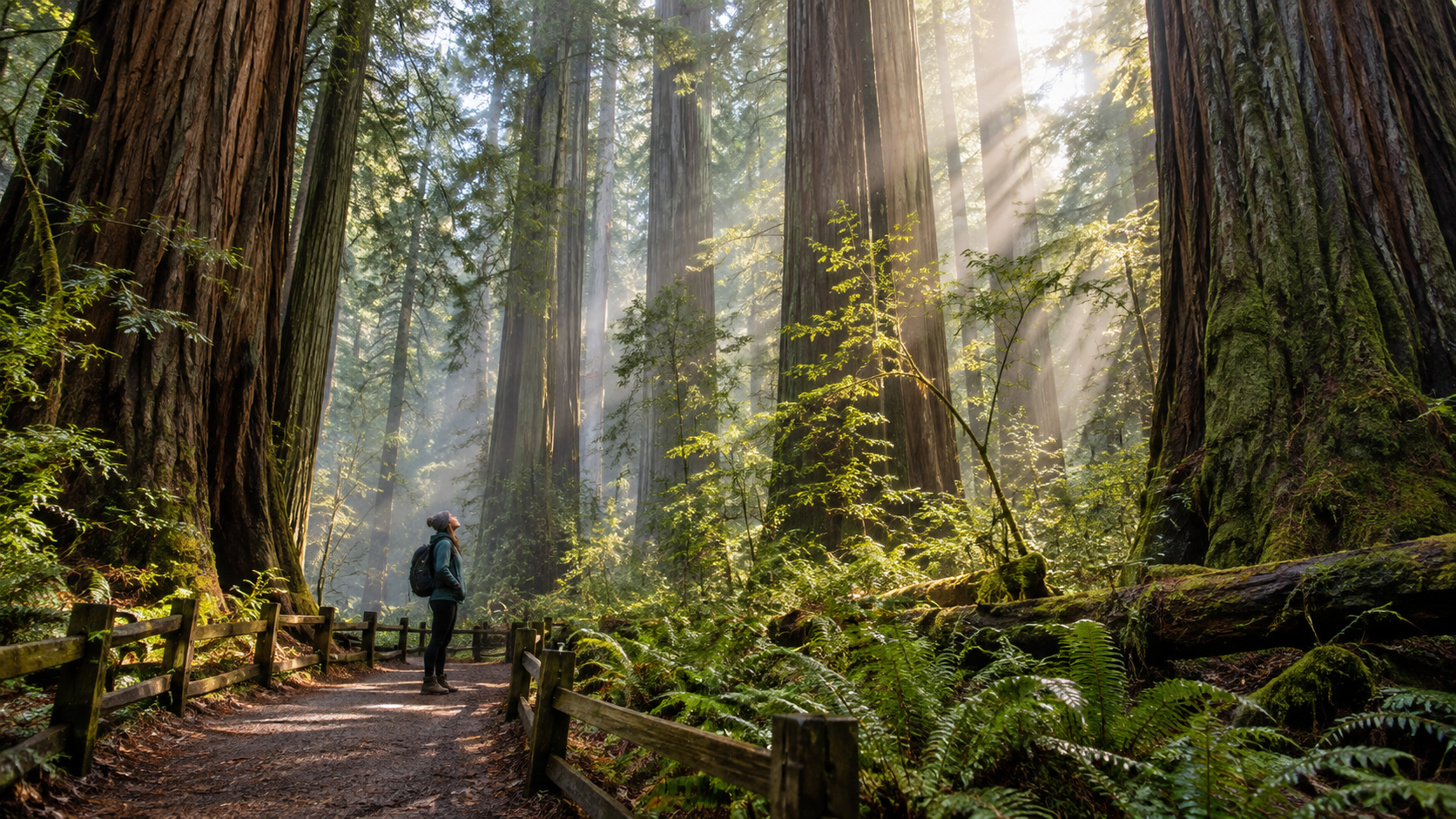
*Awe is not reserved for mountaintops, cathedrals or once-in-a-lifetime events. Research suggests that ordinary encounters with vastness and mystery can briefly shift attention away from the self and toward a larger world.*
Think of the last time something stopped you in your tracks: a dramatic sky, a powerful piece of music, an ancient tree or an idea so large that it rearranged your sense of scale. That mixture of wonder and mental stretching is what psychologists call awe.
Awe is often associated with spirituality, but it does not belong to any single religious or philosophical tradition. It can arise through nature, art, collective ritual, moral courage, science and human skill. What these experiences share is a sense of vastness—physical or conceptual—and a challenge to our usual way of understanding what we encounter.
What researchers mean by the “small self”
In a series of five studies involving 2,078 participants, researchers found that awe was associated with a reduced focus on individual concerns and greater prosocial behavior. In one field experiment, people who spent time looking up at towering trees were more helpful and reported less entitlement than people in a comparison condition.
This does not mean awe erases identity or makes a person unimportant. The “small self” describes a temporary change in perspective: personal worries occupy less of the mental frame because attention has expanded to include something larger.
Research should be interpreted with care. Awe is not a cure for anxiety, depression or loneliness, and individual studies do not prove that every awe experience causes lasting change. Still, a growing body of work makes awe an intriguing subject at the intersection of emotion, meaning and connection.
An awe walk is different from an ordinary walk
A study of older adults compared regular walks with “awe walks,” during which participants were encouraged to notice the world with fresh eyes and seek out details that inspired wonder. The awe-walk group reported greater increases in positive emotions such as compassion and gratitude during their walks, along with greater feelings of social connection and less daily distress over time. The study did not find that the group performed more helpful acts, a useful reminder that emotional effects do not automatically become behavioral ones.
You can try the practice without traveling anywhere spectacular:
1. Walk somewhere reasonably safe and unhurried.
2. Put away your phone and soften your focus on errands or exercise metrics.
3. Look for scale, pattern, complexity or unexpected beauty.
4. Notice one thing you cannot fully explain at first glance.
5. Describe it precisely, without rushing to photograph or post it.
Architecture, cloud formations, insects, music drifting from a window or the coordinated movement of a crowd can all become material for attention.
Wonder without certainty
Awe is valuable partly because it allows curiosity and humility to coexist. Scientific understanding can deepen wonder: knowing that light from a distant star has traveled for years does not make the night sky less astonishing. Spiritual reflection can give the experience personal meaning without requiring scientific claims that evidence cannot support.
The two modes need not compete. Science can investigate what happens in attention, emotion and behavior. Spirituality can ask what the experience means, what it calls us to value and how it changes our relationship to other people.
The invitation is modest: once this week, spend fifteen minutes looking for something larger than your immediate concerns. Awe may not solve the problem waiting at home. It may, however, change the size of the frame around it.
**Practical takeaway:** Take a fifteen-minute “awe walk” and deliberately notice vastness, complexity and unfamiliar detail. Leave the camera in your pocket for the first ten minutes.
**Sources:** [PubMed: Awe, the Small Self, and Prosocial Behavior](https://pubmed.ncbi.nlm.nih.gov/25984788/); [National Library of Medicine: Awe Walks in Older Adults](https://pmc.ncbi.nlm.nih.gov/articles/PMC8034841/)