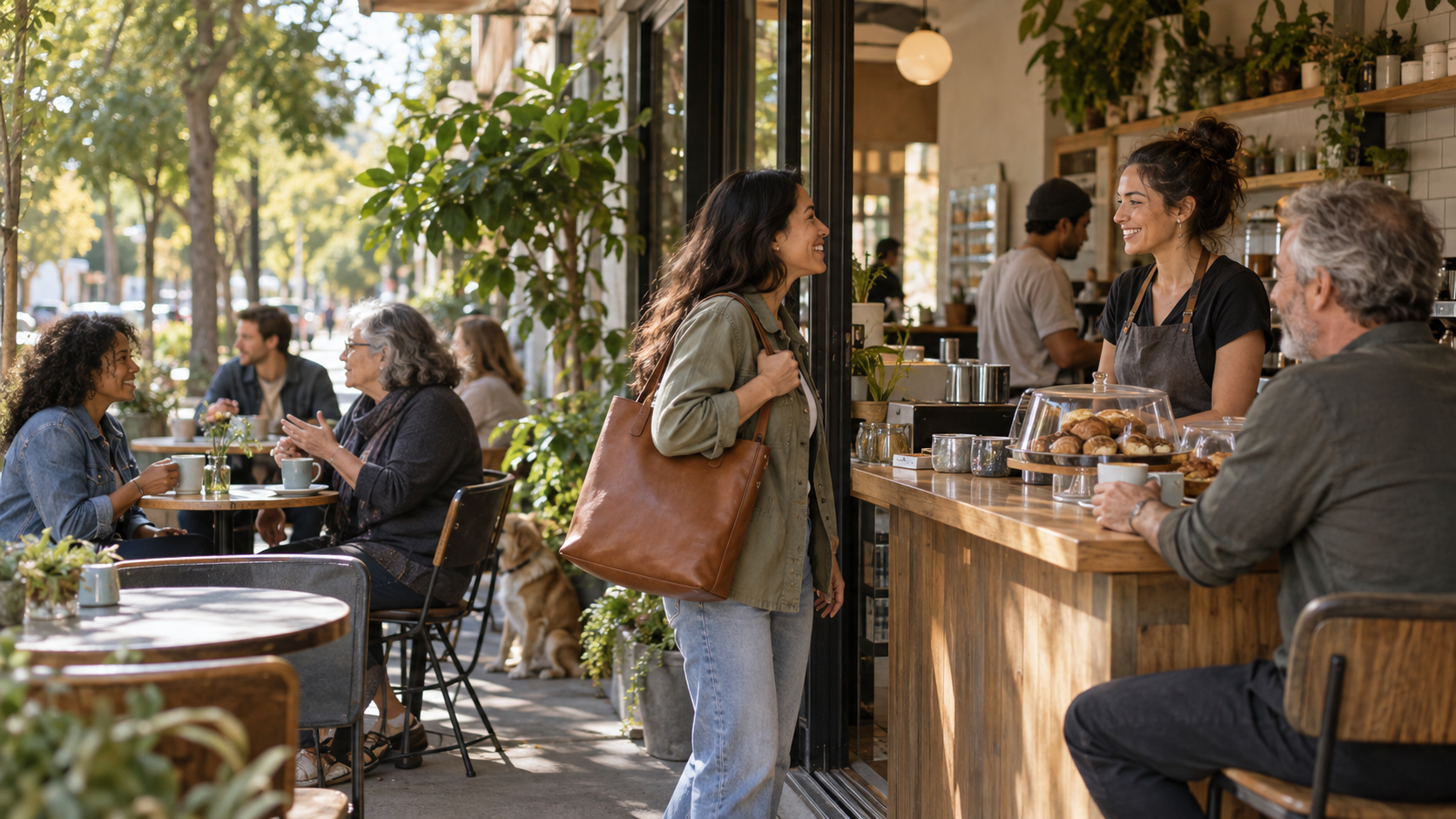
A stronger community life rarely begins with a grand gesture. More often, it starts by showing up at the same place, at roughly the same time, often enough to recognize—and be recognized by—the people around you.*
Many of us live within a few feet of other people yet know almost nothing about them. We order groceries without entering a store, stream entertainment at home and handle errands through apps. Convenience has saved time, but it has also removed many of the small encounters that once helped strangers become familiar faces.
That matters. The U.S. Surgeon General identifies social connection as an important influence on individual and community health. Social isolation has been associated with a 29% higher risk of premature death, while poor social relationships have been associated with higher risks of heart disease and stroke. Those numbers do not mean that one quiet weekend is dangerous. They do show that connection deserves to be treated as part of a healthy life—not as an optional extra.
## Familiarity is a social bridge
Friendships usually need repetition. A single conversation may be pleasant, but seeing someone regularly creates opportunities for trust to grow without the pressure of arranging a formal social event.
This is one reason cafés, parks, libraries, barbershops, community gardens, houses of worship and recreation centers can play such an important role. They are places where people can gather without having to host, impress or commit to an entire evening. Sociologists sometimes call these informal gathering spots “third places”: settings that are neither home nor work.
You do not need to be outgoing to benefit from them. The goal is not to walk into a room and collect five new friends. It is simply to create more chances for low-stakes recognition: a nod, a remembered name, a short conversation or a shared joke.
## Try the “same time, same place” experiment
Choose one public place you genuinely like and visit it at a predictable time once a week for six weeks. It might be a Saturday farmers market, a Tuesday evening fitness class, a Sunday morning coffee shop or a weekday walk in the same park.
Keep the first steps modest:
1. Put your phone away for the first ten minutes.
2. Make eye contact and greet one person.
3. Learn one name—an employee’s, a neighbor’s or another regular’s.
4. Ask a situational question: “Have you tried this before?” or “Is it always this busy?”
5. Return next week.
Consistency does much of the work. Familiarity gives both people a reason to continue the conversation later.
## Make connection useful
Shared activity often makes socializing easier. Volunteer for a defined shift, attend a recurring class, join a walking group, participate in a book discussion or help maintain a shared space. A task gives people something to talk about and reduces the awkwardness of beginning from nothing.
It also helps to become a small source of continuity. Introduce two people who share an interest. Remember a detail from an earlier conversation. Invite someone to join you next time, but make the invitation easy to decline. Community grows through repeated acts of attention.
Online communication can support this process, especially for people with limited mobility or distant loved ones. But it works best when it strengthens relationships rather than merely filling time. A direct message to one person, a scheduled video call or a neighborhood group that leads to an in-person activity is more relational than endless passive scrolling.
Belonging is rarely something we find fully formed. It is something we practice. Pick a place, return to it and let small moments accumulate. Becoming a regular is not dramatic—and that is precisely why it is achievable.
**Practical takeaway:**
Choose one nearby place or recurring activity and visit at the same time each week for six weeks. Aim for recognition before friendship.
**Sources:** [U.S. Department of Health and Human Services: Social Connection](https://www.hhs.gov/surgeongeneral/reports-and-publications/connection/index.html); [HHS recommendations for individuals and communities](https://www.hhs.gov/surgeongeneral/reports-and-publications/connection/resources/index.html)
—